Update on revisions to the ‘Supporting Transgender Pupils In Schools ’ guidance
Update on revisions to the ‘Supporting Transgender Pupils In Schools ’ guidance
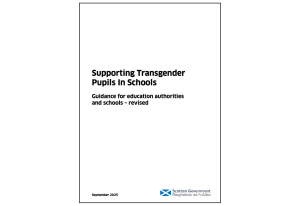
The Scottish Government published revised non-statutory guidance on supporting transgender pupils on 29 September 2025, available in full here.
This revised guidance sits within a wider landscape of equality, children’s rights, and safeguarding duties that apply across Scottish education. It follows two recent court judgments: the UK Supreme Court’s ruling on the definition of “sex” in the Equality Act 2010, and the Court of Session decision on the statutory requirement for schools to provide separate toilets for boys and girls.
It is incumbent on all education partners to consider carefully what the guidance means in practice and to contribute to a shared understanding moving forward, noting that recent commentary has prompted understandable discussion and concern.
This note aims to support parents, carers, and staff in understanding what the revised guidance says with key excerpts from it set out. It is not legal advice and should not be interpreted as such.
The guidance reflects the legal requirement for schools to provide separate toilets for boys and girls and that “the facilities require to be made available on the basis of biological sex” (p.22), while recognising that education authorities and schools should consider appropriate toilet provision for transgender pupils, which “may include the use of gender-neutral provision” (p.22).
The guidance does not propose the introduction of ‘blanket rules’ about practical arrangements for transgender pupils. It asks that schools and education authorities:
Consider each individual pupil’s needs within the context of their school environment
Consider wellbeing arrangements, children’s rights, and dignity
Liaise with the pupil and their family to consider and agree together a range of practical matters
Seek legal advice where necessary, based on the particular circumstances of individual pupils
Schools are advised to work with transgender pupils and their families to agree on practical arrangements that are lawful and balance rights. The guidance provides pathways for schools and education authorities to consider on p.22 and p.44.
It will be important for the young person, their family and the school to consider and agree together a range of practical matters, including for example how the pupil will be known, how their information will be recorded, the toilet and changing room facilities that they will use, communication with other pupils and school staff. It is necessary to consider in detail each individual pupil’s needs within the context of the particular school environment and population.
Education authorities and their schools have been asked to consider the revised guidance in relation to their responsibilities under equality and human rights law.
This guidance sits alongside a comprehensive framework of laws and policies designed to uphold the rights, safety, and wellbeing of all children and young people in Scotland, including:
The Getting it Right for Every Child (GIRFEC) framework
The Children and Young People (Scotland) Act 2014
The UNCRC (Incorporation) (Scotland) Act 2024, which places children’s rights at the heart of decision-making
The GTCS Professional Standards
The National Guidance for Child Protection in Scotland (2021, updated 2023)
Article 8 of the European Convention on Human Rights (ECHR), which protects the right to respect for private and family life – interpreted by the courts to encompass a person’s identity, dignity, and autonomy, including matters relating to gender identity
Together, these frameworks require schools to act in the best interests of every child, to safeguard wellbeing, and to ensure that decisions are proportionate and informed by individual circumstances.
Decisions on practical arrangements for transgender pupils should take proper account of their rights. Under Article 8 of the European Convention on Human Rights, transgender young people are entitled to respect for their private and family life. Any interference with those rights must be lawful, necessary, and proportionate.
The revised guidance aims to reflect this broader rights landscape by emphasising the individualised assessment of each pupil’s needs, the importance of privacy, dignity, and wellbeing in decision-making, and engagement with the young person and their family to arrive at appropriate arrangements.
It also contains important information on preventing and responding to prejudice-based bullying, pastoral care, respecting privacy, and on a broad range of issues that affect transgender pupils’ daily experience at school.
It is essential that education authorities and schools consider in detail the individual needs of transgender pupils, in light of their local circumstances, school context and the need to balance the rights of all, in light of the information that they have about those matters.
Transgender pupils are vulnerable to bullying and prejudice, particularly in a climate of heightened public discourse about their experiences. It is important that schools continue to work closely with young people and their families to ensure appropriate support, protect dignity, and uphold every child’s right to learn in a safe and respectful environment. Teachers already support young people with professionalism and are committed to contribute positively to ensure children’s rights and wellbeing remain central to education in Scotland.
More broadly, the Scottish Government has maintained its commitment to LGBT Inclusive Education. Additional guidance is available to support schools in developing an inclusive curriculum that allows children and young people to see themselves and their families reflected throughout their learning pathway, and to proactively address homophobic, biphobic, and transphobic bullying.
Further Information
We recommend that schools and education authorities engage with the revised guidance in full, available here, and continue supporting every child with dignity, safety, and respect.
Teachers and school staff can contact their trade unions directly for further advice and support on specific circumstances.
Parents and carers seeking further information can access additional resources via Parentzone Scotland, which provides advice on children’s rights and wellbeing.
To provide the best experiences, we use technologies like cookies to store and/or access device information. Consenting to these technologies will allow us to process data such as browsing behavior or unique IDs on this site. Not consenting or withdrawing consent, may adversely affect certain features and functions.
Functional
Always active
The technical storage or access is strictly necessary for the legitimate purpose of enabling the use of a specific service explicitly requested by the subscriber or user, or for the sole purpose of carrying out the transmission of a communication over an electronic communications network.
Preferences
The technical storage or access is necessary for the legitimate purpose of storing preferences that are not requested by the subscriber or user.
Statistics
The technical storage or access that is used exclusively for statistical purposes.The technical storage or access that is used exclusively for anonymous statistical purposes. Without a subpoena, voluntary compliance on the part of your Internet Service Provider, or additional records from a third party, information stored or retrieved for this purpose alone cannot usually be used to identify you.
Marketing
The technical storage or access is required to create user profiles to send advertising, or to track the user on a website or across several websites for similar marketing purposes.