
The specially designed double-decker bus, unveiled for Glasgow’s Pride on Saturday 18th July, will operate across the city throughout the coming year, carrying the message “Pride in every journey” while highlighting LGBT people whose lives and achievements have shaped science, technology, civil rights, literature, and social progress.
The launch marks the start of a wider collaboration between our charity and First Bus, focused on using education and community engagement to help address prejudice, bullying, discrimination, and antisocial behaviour.
As part of the partnership, we will also work together on a new schools initiative due to be launched later this year.
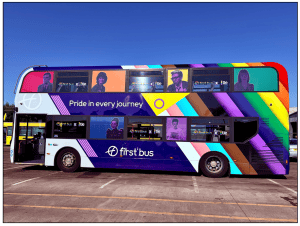
The story behind the bus
When we developed the concept for the bus with First Bus, we wanted it to do more than recognise Pride as a single annual occasion.
As an education charity, it was important for us that the bus helped shine a light on LGBT people whose stories and achievements are not always widely known and created an opportunity to raise awareness throughout the year.
The bus therefore features six significant individuals from LGBT history whose lives and achievements have left a lasting mark on our society and culture.
For many people, this may be their first introduction to the individuals featured on the bus. We hope it encourages people to learn more about their lives and achievements, as well as the challenges they faced.
Their stories highlight that LGBT people have always been part of our communities, making significant contributions across public life – often in the face of prejudice and discrimination.
Meet the six LGBT figures on the bus
Many people will instantly recognise the rainbow colours of the bus as a symbol of Pride, but fewer will recognise the six significant figures that feature on it.
That is, in part, because the lives and achievements of LGBT people have often been excluded from the history that we learned at school.
The six individuals were selected because of the lasting impact they have had. Spanning almost 500 years of history, together they represent a range of fields including science, engineering, civil rights, literature, activism, and space exploration.
Some transformed the world through groundbreaking discoveries, while others challenged discrimination and advanced equality. Each left a lasting legacy while facing inequality or prejudice because of who they were.
Alan Turing (1912 – 1954)
Alan Turing is widely regarded as one of the founders of modern computing. During the Second World War, he played a pivotal role in breaking the German Enigma code at Bletchley Park, helping Allied forces intercept encrypted military communications. Historians widely believe this work shortened the war by several years and saved millions of lives.
Despite his extraordinary achievements, Alan was prosecuted in 1952 for homosexuality, which was illegal in Britain at the time. He was subjected to chemical castration and stripped of his high-level security clearance. He died two years later, aged just 41.
In 2009, the UK Government formally apologised for his treatment, and he received a posthumous royal pardon in 2013. The 2014 feature film The Imitation Game is a biography of his life.
He was voted the greatest icon of the 20th century in a major public poll conducted by the BBC and, in 2021, he became the face of the Bank of England’s £50 note. His legacy continues to shape the modern digital world.
Sally Ride (1951 – 2012)
Sally Ride became the first American woman in space when she travelled aboard the Space Shuttle Challenger in 1983.
A physicist and NASA astronaut, Ride later dedicated much of her career to encouraging young people, particularly girls, to pursue careers in science, technology, engineering and mathematics (STEM). She founded Sally Ride Science, an organisation committed to inspiring the next generation of scientists and engineers.
It only became publicly known that she had shared a 27 year relationship with her partner, Tam O’Shaughnessy, following her death.
Sally was a trailblazer whose legacy continues to inspire generations both within and beyond the scientific community.
Bayard Rustin (1912 – 1987)
Bayard Rustin was one of the most influential organisers of the American Civil Rights Movement. A lifelong pacifist, he played a central role in organising the 1963 March on Washington for Jobs and Freedom, where Martin Luther King Jr delivered his iconic “I Have a Dream” speech. Rustin was a key adviser to King, helping to shape the movement’s commitment to nonviolent protest.
As an out gay man, Rustin frequently faced discrimination, both from wider society and within the civil rights movement itself. Despite his leadership and strategic brilliance, he was often pushed into the background because of his sexual orientation.
Throughout his life, he remained a leading advocate for civil rights and social justice. In 2013, he was posthumously awarded the Presidential Medal of Freedom, the highest civilian honour in the United States, in recognition of his extraordinary contributions to the American Civil Rights Movement.
Bayard is widely recognised as one of the movement’s most important, yet historically overlooked, figures. In 2023, Netflix released Rustin, a feature film about his life.
Lynn Conway (1938 – 2024)
Lynn Conway was a pioneering computer scientist and electrical engineer whose innovations transformed modern microchip design.
Her work underpins many of today’s computers and electronic devices. After transitioning in the late 1960s, Conway experienced significant discrimination, including being fired from her job at IBM. She received a formal apology for the firing from IBM in 2020, over five decades later. Lynn went on to become one of the world’s leading engineers while also becoming an influential advocate for transgender equality and visibility.
Marie Maitland (c.1550 – 1596)
Marie Maitland was a 16th century Scottish poet whose surviving work includes some of Europe’s earliest known love poetry between women since Sappho of Lesbos.
One of her best known works, Poem 49 of the Maitland Quarto Manuscript, is written in the Scots language and expresses Marie’s desire to marry the woman she loved.
It was written at a time when homosexuality was punishable by death in Scotland and the Scottish Witch Trials were underway, illustrating Marie’s resilience and bravery in committing her love to paper.
Her work was rediscovered by Scots linguist and historian Ashley Douglas, author of With My Own Hand: The secret life of Marie Maitland, Scotland’s sixteenth-century Sappho.
Booan Temple
Booan Temple is a lesbian activist best known for her role in one of the most iconic acts of LGBT protest in UK history.
On 23 May 1988, the evening before Section 28 came into force, Booan was among a group of lesbian activists who interrupted the BBC’s live Six O’Clock News broadcast.
Wearing “Stop the Clause” T-shirts, the protesters entered the studio to draw national attention to the legislation, which prohibited the “promotion of homosexuality” by local authorities, including in schools.
The protest became one of the defining moments of resistance to Section 28 and remains a powerful symbol of LGBT activism in Britain. Booan’s inclusion recognises the courage of those who stood up to discrimination and fought for the rights and legal protections that many now benefit from.
Have you seen the Pride bus?
If you have seen the Pride bus travelling across Glasgow, we hope you’ll take a moment to learn about the people featured on it.
Their stories highlight that progress has always been driven by individuals who challenged prejudice and stood up for equality – even when it was difficult to do so and came at great personal cost.
As the bus travels across the city over the coming year, we hope it inspires conversations and helps to ensure that LGBT history remains visible in public spaces.
If you’re a teacher, we provide a range of free curriculum resources exploring the lives and achievements of several of the figures featured on the bus.
These resources support schools to deliver LGBT Inclusive Education in line with national guidance, helping to ensure that all learners see the diverse people who have shaped our society reflected in the history they learn.


